Table of Contents
ToggleA 3 door commercial refrigerator brings serious cold storage capacity to both commercial kitchens and large households. Unlike residential units, these workhorses offer independent temperature zones, faster cooling recovery, and the kind of access that makes meal prep or business service far more efficient. Whether someone’s outfitting a catering operation, a bed-and-breakfast, or just a kitchen that feeds a crowd, understanding what separates a solid commercial unit from a glorified residential fridge can save thousands in wasted food, energy bills, and premature replacement costs.
Key Takeaways
- A 3 door commercial refrigerator offers 60-85 cubic feet of capacity with independent temperature zones, making it ideal for restaurants, catering operations, and large households that require frequent simultaneous access and high-volume cold storage.
- Quality features like commercial-grade compressors, heavy-gauge stainless steel construction, self-closing hinges, and NSF-certified shelving rated for 150-200 pounds are essential to distinguish a reliable 3 door unit from inferior alternatives.
- Energy costs for a 3 door commercial refrigerator can reach $600-$1,000 annually, but Energy Star-certified models with LED lighting and improved insulation recover their upcharge within 3-5 years through reduced electricity consumption.
- Proper installation requires 3-6 inches of side clearance, dedicated electrical circuits (typically 115V/20A or 208-230V), level flooring that supports 800-1,200 pounds, and compliance with local building codes and health department regulations.
- Regular maintenance—including condenser coil cleaning every 30-90 days, monthly door gasket inspections, and quarterly drain line flushing—extends unit lifespan and prevents costly compressor failures or refrigerant leaks.
- Budget $1,500-$3,000+ for a new 3 door commercial refrigerator, plus $200-$500 for delivery and installation; used models can offer savings but require professional pre-purchase inspection to verify compressor condition and refrigerant integrity.
What Is a 3 Door Commercial Refrigerator and Why Choose One?
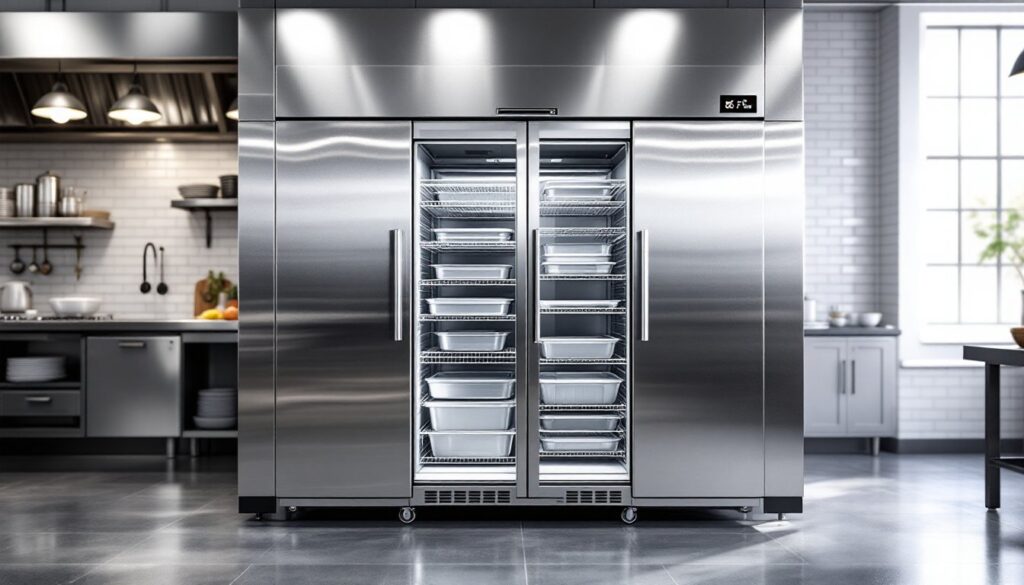
A 3 door commercial refrigerator is a reach-in unit designed for high-volume cold storage, typically measuring 72 to 81 inches wide and offering 60 to 85 cubic feet of capacity. Unlike side-by-side residential models, each door accesses its own compartment, often with independent temperature controls, which minimizes cold air loss when staff or family members retrieve items frequently throughout the day.
These units are built with heavier-gauge stainless steel exteriors, commercial-grade compressors, and reinforced shelving rated for significantly more weight than home units (often 150 to 200 pounds per shelf). The door gaskets are thicker, hinges are spring-loaded for self-closing, and interiors use NSF-certified materials that resist bacterial growth and simplify sanitation.
Choosing a 3 door model makes sense when storage needs exceed what a standard residential fridge and a standalone freezer can handle, but the operation doesn’t require a full walk-in cooler. Restaurants, cafés, juice bars, and event venues rely on them for daily service. But they’re also showing up in large family homes, hunting lodges, community kitchens, and home-based catering businesses where meal prep happens at scale. The independent compartments let users dedicate one section to dairy, another to produce, and a third to proteins, keeping cross-contamination low and organization high.
Key Features to Look for in a 3 Door Commercial Refrigerator
Not all 3 door units are created equal. The difference between a workhorse and a headache often comes down to a handful of core features.
Compressor placement matters more than most buyers realize. Top-mounted compressors are easier to service and keep condenser coils away from floor-level dust and grease, but they reduce interior height. Bottom-mounted units maximize interior cubic footage and are common in tight prep areas. Side-mounted compressors are rare but useful in spaces with low ceilings.
Door construction should include self-closing hinges and heavy-duty gaskets. Magnetic gaskets alone won’t cut it in a busy environment, look for cam-lift or spring-loaded hinges that pull doors shut from about a 45-degree angle. Check whether doors are field-reversible: not all models allow hinge swaps without a service call.
Shelving should be epoxy-coated or stainless steel wire grid, both NSF-listed. Adjustable shelf clips on a 1-inch pitch let users reconfigure height for sheet pans, stock pots, or bulk ingredient containers. Verify the per-shelf weight rating, cheaper units max out around 75 pounds, which won’t hold a full Cambro of soup or a case of produce.
Consider whether the unit offers digital temperature displays for each compartment. Analog dial thermometers are harder to monitor and adjust precisely, and they don’t typically log data. Many 2026 models include Wi-Fi connectivity for remote alerts if a door is left ajar or a compressor fails overnight, worth the upcharge for anyone storing perishable inventory.
Temperature Control and Energy Efficiency
Temperature consistency is non-negotiable. Commercial units should hold 33°F to 38°F in refrigerator mode with no more than ±2°F variation during door openings. Forced-air (fan-driven) cooling distributes cold air more evenly than static systems, which is critical when the unit is packed full.
Look for Energy Star certification or equivalent. A 3 door commercial fridge can pull 8 to 12 amps continuously, adding $600 to $1,000 per year to an electric bill depending on local rates. Units with LED interior lighting, high-efficiency compressors, and improved insulation (at least 2 inches of polyurethane foam) pay for themselves within three to five years.
Defrost cycles also impact efficiency. Auto-defrost systems add convenience but cycle compressors more frequently. Manual-defrost units save energy but require scheduled downtime, realistic only in lower-humidity climates or during slow periods. Many commercial models now offer programmable defrost timers to run cycles during off-peak hours.
Best Uses: Where a 3 Door Commercial Refrigerator Shines
The 3 door configuration excels in environments where multiple users need simultaneous access or where ingredient organization directly affects speed and safety.
Restaurants and cafés use them as prep-line or backup refrigeration. Line cooks can grab dairy from one door, prepped vegetables from another, and proteins from the third without crossing paths. This reduces bottlenecks during peak service and keeps food at safer temps since each door opening affects only one-third of the total cold space.
Catering operations benefit from the ability to stage multiple events at once, one door per menu or client, without flavor transfer. The capacity handles full sheet pans (18 x 26 inches), hotel pans, and bulk containers that won’t fit in residential units.
Bed-and-breakfasts, hunting lodges, and large households find value when feeding eight or more people daily. The ability to store a week’s worth of groceries, prep multiple meals in advance, and separate raw from ready-to-eat items makes the commercial format more practical than adding a second residential fridge.
Juice bars, florists, and homebrew enthusiasts appreciate stable, independent temperature zones. Flowers hold best at 34°F to 36°F, while some fresh juices and ferments need slightly warmer or cooler ranges. A 3 door unit accommodates these variations without compromise.
For inspiration on integrating a commercial unit into home kitchens or hybrid spaces, examples on commercial refrigerator layouts show how designers balance utility with aesthetics.
Installation and Space Planning Tips
Measure twice, order once. Commercial refrigerators are not plug-and-play appliances.
Dimensional clearances are non-negotiable. Most 3 door units need 3 to 6 inches of clearance on all sides for airflow. Top-mounted compressor models require an additional 12 inches above for heat dissipation. Doorway widths must accommodate the unit’s depth, typically 32 to 36 inches, plus dolly clearance. Remove doors and hinges if necessary, but verify whether doing so voids the warranty.
Electrical requirements vary by model, but most 3 door units run on 115V/15A or 115V/20A dedicated circuits. Larger or more feature-rich models may require 208-230V service, which means hiring a licensed electrician to install a new circuit. Use a GFCI-protected outlet in compliance with NEC Article 422.5 if the unit is within six feet of a sink. Never use an extension cord or share a circuit with other high-draw appliances.
Flooring under the unit should be level, smooth, and capable of supporting 800 to 1,200 pounds fully loaded. Vinyl, sealed concrete, and commercial-grade tile all work. Avoid soft or uneven surfaces, compressor vibration on an unlevel floor accelerates wear on internal components and door seals. Adjustable legs or casters (most models include both) should be set so the unit tilts very slightly toward the back, ensuring doors self-close properly.
Ventilation is critical. If installing in a garage, basement, or enclosed porch, ensure ambient temperatures stay between 50°F and 95°F. Compressors struggle in unheated spaces during winter or poorly ventilated areas in summer. Some jurisdictions require mechanical ventilation for commercial refrigeration in residential zones, check with the local building department before installation.
Check whether a permit is required. In many areas, adding a commercial appliance to a residence triggers a code review, especially if upgrading electrical service. If the space is part of a licensed food business, health department approval and regular inspections will apply.
Maintenance and Troubleshooting for Longevity
Commercial refrigerators demand routine upkeep. Skipping maintenance turns a ten-year appliance into a three-year money pit.
Condenser coil cleaning is the single most important task. Dirty coils force the compressor to work harder, spiking energy use and shortening lifespan. Clean coils every 30 to 90 days depending on environment, more often in dusty, high-traffic, or pet-filled spaces. Use a coil brush and a shop vacuum: compressed air just redistributes dust. Many professionals recommend appliance maintenance tools that simplify the process without risking coil damage.
Door gasket inspection should happen monthly. Run a dollar bill test: close a bill in the door and try to pull it out. If it slides easily, the gasket isn’t sealing. Clean gaskets with warm soapy water and check for cracks or warping. Replacement gaskets cost $50 to $150 per door but prevent thousands in lost cooling efficiency.
Drain line maintenance prevents water pooling inside the unit or under it. Auto-defrost models have a condensate pan and drain tube that can clog with food particles or mineral deposits. Flush the drain line quarterly with a mixture of warm water and a few drops of dish soap. If water backs up, use a turkey baster or a small drain snake to clear the blockage.
Temperature logs are worth keeping, especially for businesses subject to health inspections. Record temps twice daily, morning and evening, and note any deviations. A gradual upward trend often signals a failing compressor, refrigerant leak, or faulty thermostat. Catching it early can mean a $300 repair instead of a $2,000 replacement.
Common issues and fixes:
- Unit runs constantly but doesn’t cool: Check condenser coils first, then door gaskets. If both are clean and tight, the system may be low on refrigerant, call a licensed HVAC tech.
- Frost buildup inside: Usually a sign of a faulty door gasket or a malfunctioning defrost timer. Inspect and replace as needed.
- Loud or irregular compressor noise: Could indicate worn motor mounts, a failing fan, or compressor damage. If the noise is new or worsening, get a professional assessment before the unit fails completely.
Safety note: Commercial refrigerators use refrigerants regulated under EPA Section 608. Only certified technicians can legally service refrigerant systems. DIYers can handle coils, gaskets, and drain lines, but anything involving the sealed system requires a pro.
Top Considerations Before Buying Your 3 Door Commercial Refrigerator
Price alone shouldn’t drive the decision. A $1,500 unit that fails in two years costs more than a $3,000 workhorse that runs for a decade.
New vs. used: Used commercial refrigerators can be a smart buy if sourced from a restaurant supply liquidator with some service history. Avoid units with unknown provenance, compressor hours, refrigerant condition, and gasket wear are invisible until it’s too late. Budget $300 to $500 for a professional inspection before purchasing used.
Brand and warranty: Stick with manufacturers known for parts availability and service networks. A five-year compressor warranty and a two-year parts warranty are standard for quality units. Verify whether labor is covered and whether the warranty is void if a non-certified tech performs service.
Delivery and installation costs: Commercial units weigh 400 to 600 pounds empty. Factor in $200 to $500 for delivery, uncrating, and positioning. If electrical work is needed, add another $150 to $400 depending on circuit requirements.
Operating costs: Beyond the sticker price, calculate annual energy use. A unit pulling 10 amps at 115V running 24/7 costs roughly $700 per year at $0.13/kWh. Energy Star models can cut that by 20% to 30%. For comprehensive product testing and efficiency ratings, appliance reviews often compare real-world performance across brands.
Resale and code compliance: If installing in a home, confirm that local zoning allows commercial equipment. Some HOAs or residential codes restrict commercial appliances due to noise or aesthetic concerns. If planning to sell the home eventually, a built-in commercial fridge may appeal to buyers with home businesses, or turn off traditional homebuyers. Understand the market before committing.
Finally, think about future needs. A 3 door unit is a significant investment. If storage needs might grow, consider whether a larger unit or a walk-in cooler makes more sense in the long run. Conversely, if needs could shrink, such as a catering business scaling back, factor in depreciation and resale value.