Table of Contents
ToggleA 3 drawer filing cabinet isn’t just for insurance policies and tax returns anymore. It’s become a workhorse in home offices, craft rooms, and even converted closets, offering a balance of capacity, footprint, and cost that smaller or larger units can’t match. Whether you’re setting up a workspace from scratch or finally tackling that pile of manuals, receipts, and project files, the right filing cabinet keeps everything accessible without eating up floor space. This guide walks through what separates a solid unit from a wobbly mess, how to set up an organized system that actually sticks, and a few tricks to make metal or laminate furniture look intentional in your home.
Key Takeaways
- A 3 drawer filing cabinet provides the ideal balance of storage capacity (4,500–6,000 sheets), affordability ($80–$600 depending on materials), and space efficiency for home offices and small workspaces.
- When selecting a 3 drawer filing cabinet, prioritize 18–22 gauge steel construction, ball-bearing drawer slides, and locking mechanisms to ensure durability and security for sensitive documents.
- Organize your 3 drawer filing cabinet by assigning each drawer a purpose—active files in top, semi-active in middle, and archives in bottom—then label everything clearly and avoid overloading folders to prevent jamming.
- Transform a basic steel filing cabinet’s appearance through spray painting in modern colors, upgrading hardware, or adding a wood-grain contact paper veneer without compromising functionality.
- Implement a tickler file system with monthly and daily folders in your top drawer to manage recurring bills, reminders, and deadlines more effectively.
- Keep an incoming paper tray on top of the cabinet and sort it weekly to prevent clutter from accumulating on your desk and undermining your filing system’s effectiveness.
Why a 3 Drawer Filing Cabinet Is the Perfect Storage Sweet Spot
Three drawers hit a Goldilocks zone for home use. Two-drawer units often leave you cramped within a year, especially if you’re managing household records, client files, or hobby materials. Four- or five-drawer vertical cabinets can tip if the top drawer is loaded and opened at the same time, and they’re a pain to anchor in spaces with baseboard heat or tight corners.
A 3 drawer filing cabinet typically stands between 40 and 42 inches tall, which puts the top drawer at a comfortable working height when seated. The footprint is usually 15 to 18 inches deep and 15 to 28 inches wide depending on whether it’s designed for letter or legal-size files. That means it fits under most windows, tucks beside a desk, or slides into a closet without blocking shelves above.
Capacity-wise, you’re looking at roughly 4,500 to 6,000 sheets of paper across all three drawers if using hanging file folders, more than enough for most households unless you’re storing archives or running a business from home. If you need deeper storage for blueprints, poster boards, or craft supplies, look for units marketed as “lateral” rather than “vertical,” which run wider but shallower.
Cost also favors the three-drawer layout. Entry-level steel units start around $80 to $120, while solid wood or high-end commercial models run $300 to $600. You’re not paying for the extra drawer you might never fill, but you’re also not stuck with a dinky unit that forces a second purchase later.
Key Features to Look for When Buying a 3 Drawer Filing Cabinet
Material and Construction Quality
Steel cabinets dominate the market because they’re durable, fire-resistant, and affordable. Look for 18- to 22-gauge steel, the lower the number, the thicker and sturdier the material. Cheaper units use 24-gauge or higher, which dents easily and can warp if drawers are overloaded. Powder-coated finishes resist scratches better than painted surfaces.
Wood and laminate cabinets offer better aesthetics if the unit will be visible in a living space. Solid hardwood (oak, maple, or walnut) can support heavier loads and lasts decades, but expect to pay a premium. Particleboard or MDF cabinets wrapped in veneer are lighter and cheaper, but they sag under weight and fail quickly in humid basements. Check that drawer boxes use dovetail or dado joints rather than staples or glue alone, those joints hold up under repeated opening and closing.
Mobile units with casters can be handy in tight spaces, but confirm the wheels lock and the base frame is reinforced. Unlocked casters on a loaded cabinet are a tipping hazard, especially on carpet.
Drawer Suspension and Locking Mechanisms
Ball-bearing slides are the gold standard. They support more weight (typically 75 to 100 pounds per drawer), glide smoothly even when fully loaded, and last longer than cheaper nylon roller slides. Full-extension slides let you access the back of the drawer without yanking files forward, critical if you’re storing anything besides standard folders.
Avoid cabinets with friction slides (where the drawer just rests on a metal rail). They bind, stick, and wear out quickly. You’ll know a unit uses friction slides if the price is unusually low and the product specs don’t mention ball bearings.
Many filing cabinets include a lock bar that secures all drawers with a single key. This runs vertically behind the drawer fronts: when locked, a metal bar blocks each drawer from opening. If you’re storing sensitive documents, medical records, financial statements, or client data, this is non-negotiable. Cheap locks are easy to pick, so if security matters, budget for a unit with a tubular or cam lock rather than a wafer lock.
Some cabinets also feature an interlock mechanism that prevents more than one drawer from opening at once. This stops the unit from tipping forward when a top drawer is pulled out while a bottom drawer is already open. It’s a worthwhile safety feature if kids or pets are around, or if the cabinet will sit on a rug rather than a hard floor.
How to Organize Your 3 Drawer Filing Cabinet for Maximum Efficiency
Start with hanging file folders sized for your cabinet (letter or legal). Use the green or manila pressboard variety for durability: plastic folders crack over time. Avoid overloading each folder, 15 to 20 sheets max, or the rails will bend and drawers will jam.
Assign each drawer a purpose:
- Top drawer: Active files you reference weekly, current bills, ongoing projects, warranties for recent purchases.
- Middle drawer: Semi-active files, last year’s taxes, instruction manuals, medical records.
- Bottom drawer: Archive or deep storage, old tax returns (keep for seven years per IRS guidance), canceled insurance policies, completed project folders.
Label folders clearly with a label maker or printed adhesive labels. Handwritten labels fade and smudge. Use broad categories at the front of each drawer (“Utilities,” “Medical,” “Auto”) and break them into subcategories within.
Many home organization systems recommend a tickler file setup: 12 monthly folders and 31 daily folders in the top drawer. Drop bills, reminders, and tasks into the relevant day or month. It’s overkill for some households, but if you’re managing multiple deadlines or recurring maintenance tasks, it works.
For non-paper storage, use drawer dividers or small bins to corral pens, USB drives, or small tools. The bottom drawer can also hold rolled blueprints, poster tubes, or long-handled tools if you remove the hanging file frame.
Keep a small bin or tray on top of the cabinet for incoming papers. Sort it weekly and file promptly. Letting papers pile up on your desk defeats the purpose of organized drawers.
Styling Your Filing Cabinet to Match Your Home Office or Interior
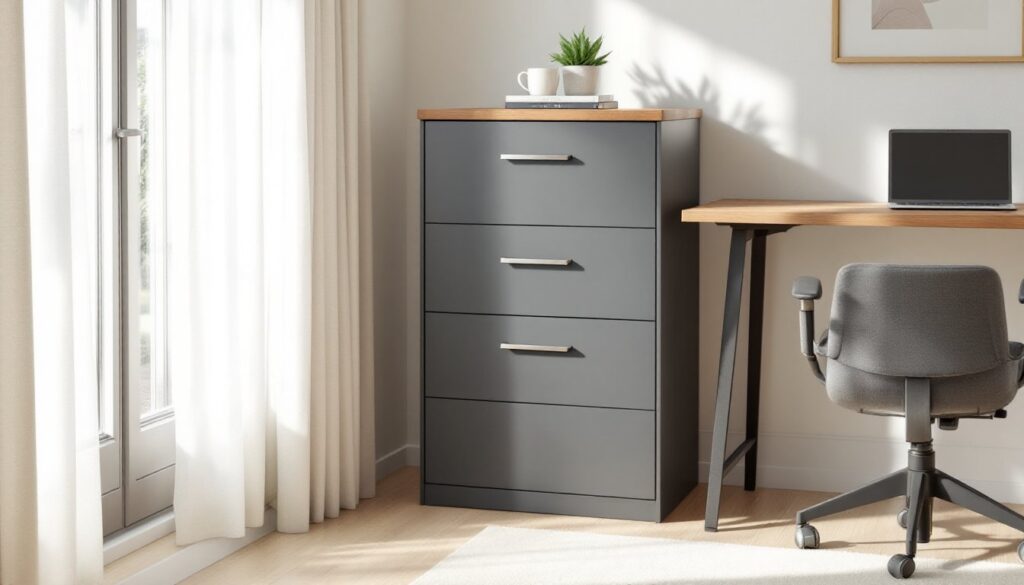
Steel filing cabinets don’t have to look institutional. A spray-painted finish in a bold color, navy, sage green, or matte black, transforms a thrift-store find. Clean the surface with degreaser, sand lightly with 220-grit sandpaper, apply a bonding primer, then two coats of enamel spray paint. Let each coat cure for 24 hours. Seal with a clear matte topcoat if the surface will see heavy use.
Wood-grain contact paper or peel-and-stick veneer can cover dented or scratched panels. Measure carefully and use a squeegee to avoid bubbles. This works best on flat drawer fronts: curved or embossed surfaces won’t adhere well.
Swap out stock drawer pulls for brushed brass, leather, or ceramic knobs. Most filing cabinets use a standard 3- or 4-inch center-to-center spacing for handles. Pre-drill carefully if adding new holes, steel requires a cobalt or titanium drill bit and cutting oil to prevent the bit from overheating.
Top the cabinet with a wood slab, butcher block, or tempered glass to create a secondary work surface or display area. Cut a piece of ¾-inch plywood to size, sand the edges, and finish with polyurethane or tung oil. Secure it with rubber bumpers or felt pads underneath to prevent scratches and keep it from sliding.
If the cabinet will be visible from a living area, place it inside a closet or built-in nook with a curtain or sliding door. This keeps the workspace functional but out of sight. Alternatively, use the cabinet as a room divider in an open-plan space, paint both sides and style the top like a console table.
For a more polished look, many design-focused tutorials suggest flanking the filing cabinet with matching bookshelves or storage cubes to create a cohesive wall unit. This works especially well in small home offices where every piece of furniture needs to pull double duty.
Conclusion
A well-chosen 3 drawer filing cabinet does more than hide paperwork, it anchors a functional workspace and keeps projects on track. Focus on sturdy construction, smooth drawer slides, and a layout that fits how you actually work. With a little paint or hardware, even a basic steel unit can look at home in a finished room.